
The hub of the depot network
Richmond Depot
Ocean Legacy Plastic Pollution Emergency Response™ Facility, Steveston Harbour
Ocean Legacy's recycling facility at Steveston Harbour, and the hub every depot ships to. Drop-offs by appointment.
Ocean Plastic Depot is an Ocean Legacy program
Seven depots across Canada, from British Columbia to Nova Scotia, take in marine debris from ocean, beach and shoreline cleanups: ghost gear, rope, net, crab pots, polystyrene, dock foam, buoys, foam floats, tires and wetsuits. Everything is sorted and shipped to Ocean Legacy’s facility in Richmond, BC, and recycled into Legacy Plastic™.
of recovered marine plastic diverted from landfills by our depots since 2020.
We accept select ocean plastic materials at the following locations. Access is different at each depot, so check your depot’s page before you load up.
The hub of the depot network
Ocean Legacy Plastic Pollution Emergency Response™ Facility, Steveston Harbour
Ocean Legacy's recycling facility at Steveston Harbour, and the hub every depot ships to. Drop-offs by appointment.
Ucluelet, BC
1500 Alaska Pine RoadAt the West Coast Landfill. Open to members 10 am to 4 pm, Monday to Saturday.
Powell River, BC
4924 Marine AvenueCanada's first Ocean Plastic Depot, at the Resource Recovery Centre. Monday to Saturday, 8 am to 5 pm, after a first-time orientation.
Port McNeill, BC
Highway 19, between Port McNeill and the Port Alice junctionAt the 7 Mile Landfill and Recycling Centre on Highway 19. Register before your first drop-off.
Cumberland, BC
3699 Bevan RoadAt the Comox Valley Waste Management Centre. By appointment only.
Sechelt, BC
4901 Dusty RoadAt the Sechelt Landfill. Temporarily closed. Please contact us before making a trip.
Brooklyn, Nova Scotia
3026 Lighthouse RouteOn Nova Scotia's South Shore. Rope and netting only. Contact us before you drop off.
Ocean Plastic Depots take marine plastic from cleanups and end-of-life gear from the marine sector. Here is the full list, in plain text and on our depot signs.
Not all materials are accepted at every depot. Please contact your depot to confirm what it can take.
If your item is not on the accepted list, we are not yet able to recycle it, or your regional district already has a local recycling option. Household recycling belongs in your local program.
Place everything in a provided storage bag, unless it is too big to fit.
Empty the water out of every item before bagging it for transport.
Fill super sacks as the depot signs show, then tie the top closed.
Each storage bag has a category and picture sign beside it.


Worn-out wetsuits can now come to the depot with the rest of your sorted marine plastic. Ask your depot before your first wetsuit drop-off.
Download our handy sorting guide and keep it with your cleanup kit.
Each depot has its own access: membership, a short first-time orientation, or an appointment. Start on your depot's page.
Separate rope, netting, foam and hard plastics. The sorting guide shows every category.
Place items in the storage bags provided, drain any water, and tie the bags closed.
Depots send full loads to our Richmond facility, where the plastic becomes Legacy Plastic™.
Ocean Plastic Depots support coastal communities to manage the burden of plastic pollution that washes up with every tide. Without infrastructure to divert these materials, literally tonnes of reusable and recyclable marine plastic resources are buried in landfills every year. Ocean Plastic Depots provide communities with a secure site to sort and store debris before onward shipping to Ocean Legacy’s processing facility in Richmond.
Where capacity exists, depots are also equipped with primary processing capabilities, allowing some materials to be repurposed within the communities where they were recovered and reducing the need for onward shipping.
Ultimately, depots reduce waste, reduce greenhouse gas emissions, and support ocean stewardship within the communities that need them the most.


These depots also provide a much-needed service for aquaculture, fishing, and marine industries to participate in responsible stewardship practices for their legacy equipment. Collating these materials at depots allows us to ship fewer, larger loads, saving on fuel and reducing greenhouse gas emissions.
Businesses interested in recycling larger volumes of legacy plastics should contact us for direct shipping enquiries. Our Marine Plastic Management Program helps marine businesses manage end-of-life equipment responsibly.

Ocean Legacy, in partnership with the Province of BC and the shíshálh Nation, launched a pilot program in 2026 that collects and responsibly manages foam dock floats from within the shíshálh swiya Dock Management Plan area.

Contact us about our membership options for individuals, cleanup organizations and industry. Choose the depot closest to you on the contact form so your message reaches the right inbox.
If you have large-volume recycling needs, tell us in your message. We will contact you about direct shipping and whether a membership fee is required.
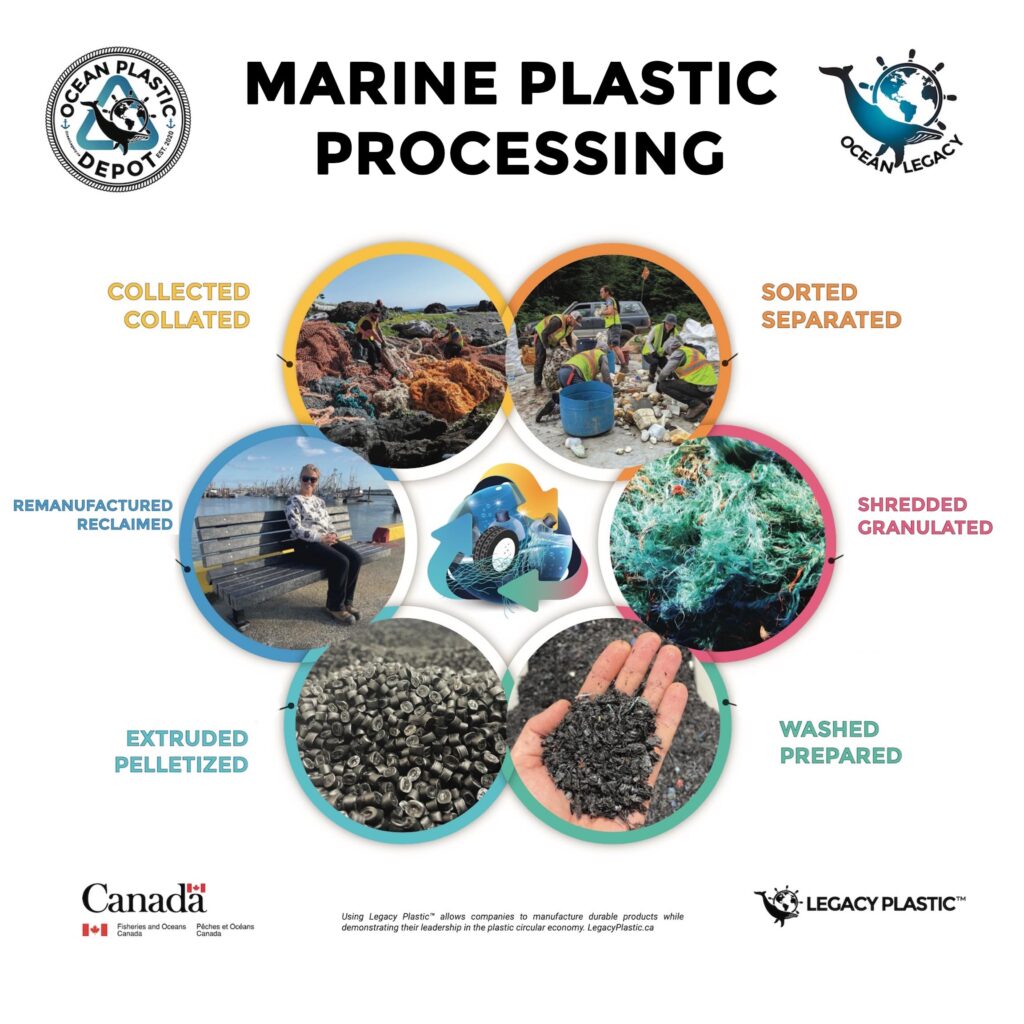
At our Richmond facility, recovered marine plastic is sorted, washed, shredded and turned into Legacy Plastic™ pellets. Manufacturers use those pellets to make durable new products. These are some examples of products made with the plastic we take in:

An Ocean Plastic Depot is a drop-off site for marine debris collected during ocean, beach and shoreline cleanups, and for end-of-life gear from the fishing, aquaculture and marine industries. Material is sorted and stored at the depot, then shipped to Ocean Legacy's facility in Richmond, BC, where it is recycled into Legacy Plastic™. Ocean Legacy has run the depot network since 2020.
There are seven Ocean Plastic Depot locations across Canada. In British Columbia: Richmond (Steveston Harbour), Ucluelet, Powell River (qathet Regional Depot), Port McNeill (7 Mile Depot), Cumberland and Sechelt. In Nova Scotia: the Atlantic Depot in Brooklyn, which accepts rope and netting only.
Depots accept marine plastic such as rope, netting and ghost gear, crab pots and traps, buoys and hard plastic floats, foam floats and dock foam, clean white polystyrene, tires, hard plastics and HDPE pipe, and wetsuits. Not every material is accepted at every depot, so check with your depot before you go.
Depots do not accept hazardous materials or batteries, liquids, wood, metal, glass or fibreglass, soft plastics such as bags and wrappers, coloured Styrofoam, PVC or ABS pipe and tubing, lighters or tennis balls. Depots are also not a replacement for household recycling.
Depots are open to community members, cleanup organizations and marine businesses. Each depot has its own access: some are open to members, some need a short first-time orientation, and some are by appointment. Community shoreline cleanup drop-offs are free at most depots once you are registered. Large-volume loads are arranged directly with Ocean Legacy and may need a membership.
Sort materials by type using the sorting guide. Place everything in a provided storage bag unless it is too big to fit, empty out any water, and tie the top of the bag closed. Loose items and standing water cannot be transported.
Contact us before you bring it in. Businesses and projects with larger volumes of end-of-life marine plastics, including dock renovations, can arrange direct shipping to Ocean Legacy's facility in Richmond, BC, often through the Marine Plastic Management Program.
Depots consolidate material into fewer, larger loads and ship it to Ocean Legacy's facility at Steveston Harbour in Richmond, BC. There it is sorted, washed, shredded and turned into Legacy Plastic™ pellets, which are made into products such as plastic lumber, planters, pails, garden tools and boats.
Yes. Ocean Legacy's Plastic Pollution Emergency Response™ Facility at 61-3300 Chatham Street, at Steveston Harbour in Richmond, BC, is also an Ocean Plastic Depot. Drop-offs there are by appointment only. Call (604) 214-3591 before you visit.
More answers about depots and recycling are in the Ocean Legacy FAQ.
Donations help operate Ocean Plastic Depots so communities can collect and divert marine plastic responsibly.


